The bike clicks under load: what to check
It's quiet on a light transmission, and a click is heard in the ascent. It is impossible to determine a broken part by one sound: the task of the first checks is to understand the conditions for the appearance of noise and notice dangerous signs before the next trip.
When to stop driving
For pedal failure, there is separate analysis of chain skipping. Here we consider clicks and noise searching without assuming that any sound means skipping.
Pedal failure is a separate symptom: the force suddenly ceases to be transmitted to the wheel. The mechanic needs to check the chain, cassette and freewheel mechanism of the sleeve. Clicking without failure also requires a search, but by itself does not prove the wear of the cassette.
Trek Manual, Inspect your bike section It recommends stopping driving with backlash or grinding in the connecting rod system. Suspicion of a crack is also a reason to stop, for Park Tool's guide to noise.
1. Write down exactly when it clicks
Remember the last trip: sitting or standing, in each gear or one, while pedaling or also rolling. What happened before the noise appeared — washing, replacing the chain, removing the wheel, falling? Write down the conditions while they are fresh in your memory.
- Only while sitting
- The saddle, its mount and seatpost become candidates for verification. This is a direction of search, not a proven diagnosis.
- Synchronously with the rotation of the pedals
- Start with shoes, pedals, connecting rods and a front star. The carriage is one of the candidates, but it's too early to change it just because of the rhythm of clicks.
- Only in one gear, especially with a jerk
- We need to check the switching, the circuit and the corresponding cassette star.
- Also coasting, with the rhythm of the wheel rotation
- See if the wheel touches the brake or accessory; check the wheel attachment. Describe the mechanics separately by rolling noise.
This fork is an editorial way to organize observations. Several nodes are loaded at the same time, so changing the sound only narrows the search. Do not shoot video with your phone in your hand on the go: it is enough to record audio with an assistant in a safe environment.
2. Start with what is visible from the outside
- On a standing bike, check if the canteen, pump, bag or the end of the cable is not knocking. Remove the loose strap and lace from the rotating parts.
- Inspect the shoes and the spikes of the contact pedals: there is no dirt, obvious displacement or damage.
- Check if the wheel is installed correctly, especially if it has been removed recently. The mount must be closed according to the instructions of its axis or eccentric.
- Easily swing the connecting rods across the frame and each pedal relative to the connecting rod. A clear knock or backlash is a reason to complete a home check and contact the service.
Then shake the saddle slightly: there should be no visible movement in the mount. Do not tighten all the bolts at random in a row. For spikes, pedals, connecting rods and seatpost, different instructions and moments are needed.
Devinci lists the sources of the squeaks: Transmission, saddle, steering and suspension mounts. This explains why replacing one part without inspection may not help.
3. Inspect the circuit without load
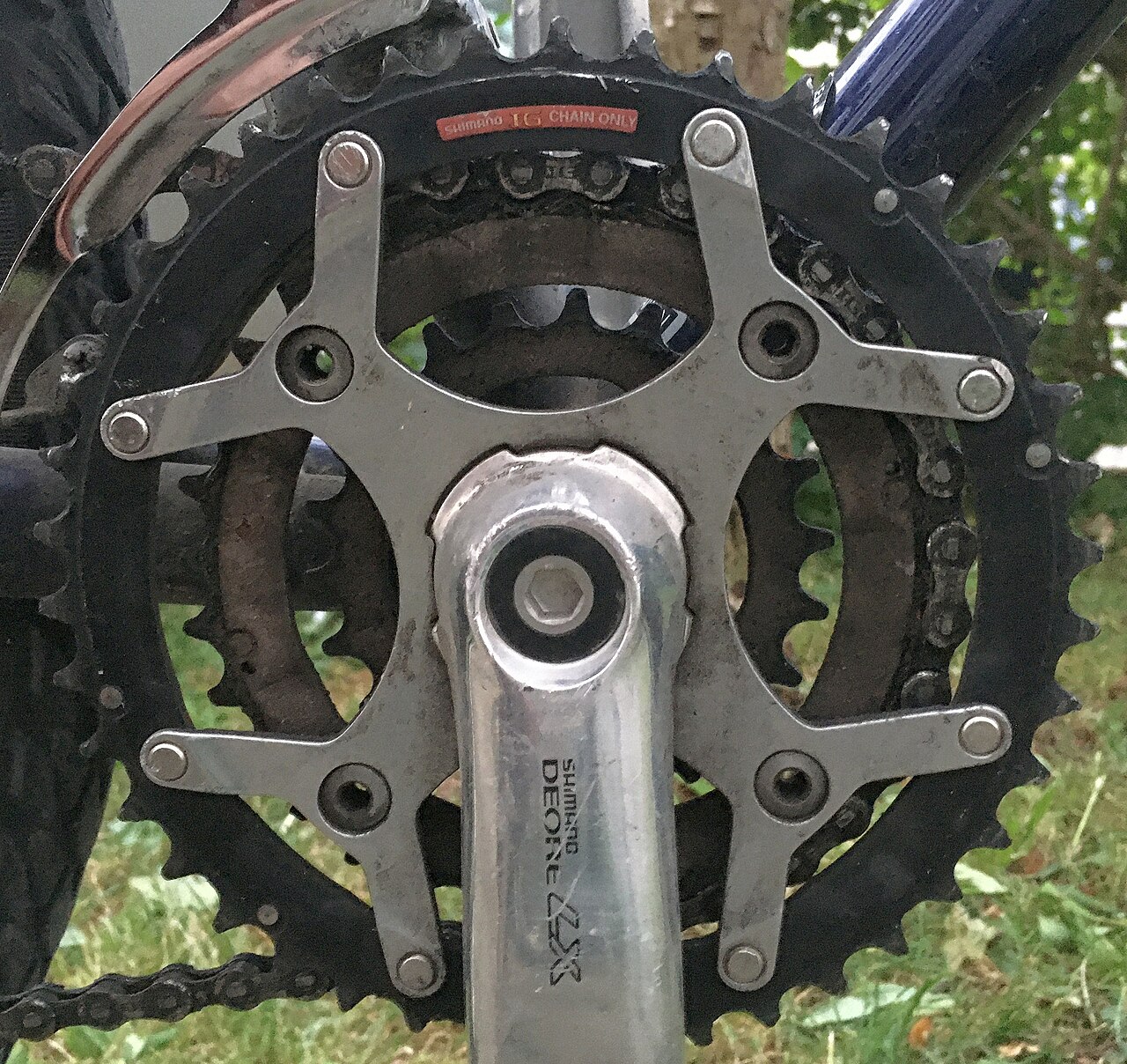
If the bike is stable in the repair rack, slowly scroll the transmission with your hand on the pedal. Do not bring your fingers to the chain, sprockets and rollers. See if there is a damaged plate, a poorly connected link, or a link that noticeably jams when the roller passes. Without a rack, limit yourself to inspecting a stationary chain.
The cleaning and application procedure is described in guide on chain lubrication. For minor adjustments to a working cable system, there is Indexing instructions; it does not replace finding the source of the clicking noise.
Clean the dirty chain with a suitable tool. Service it according to the rules of the lubricant used: a wax chain and a chain with liquid oil require different care. Do not spray oil near the brakes. Measure wear with a suitable tool: how to check the chain.
Rotation without load may not reproduce the malfunction. The silence in the rack does not confirm that the click in the lift has disappeared. The Park Tool describes the inspection of the circuit and other possible sources in diagnosis of noisy transmission.
.jpg)
4. Select a service and describe the problem
After external checks, a click is saved — order diagnostics of noise under load. Ask if the mechanic can reproduce it: the usual shift setting or inspection in the rack may not be enough. Do not buy a carriage until the cause is established.
In catalog of workshops with works on transmission select your city; Saint Petersburg is shown by default. To begin with, you can see Crazy Pedros Workshop and Birota. These are examples from the catalog, and not participants in the preparation of the article; please confirm working with your model and recording directly.
After the repair, specify the reason found and the work performed. If the dangerous signs are eliminated, check the result in a short quiet trip, starting with a small effort. The return of a click or failure is a reason to stop and return to the service.
Sources and boundaries of verification
The material was prepared by the FATRACING editorial office for technical manuals. The inspection by the invited mechanic has not yet been carried out. The instruction of your model determines the order of maintenance, tightening torques and compatibility.
- Park Tool: Troubleshooting a Noisy Drivetrain — nodes that can make noise, inspection of the chain, signs of damage to the frame.
- Devinci: Squeaks ’n’ creaks — transmission, mounts, saddle and suspension.
- Trek: Owner's Guide, March 2026 — check connecting rods and pedals to stop driving.
Sources verified on October 9, 2026. The numerical tightening torques indicated in the general articles have not been transferred here: they must be taken from the documentation of the installed component.