When to change the chain and how to determine its length
The wear and the length of the new chain are two different tasks. Wear is measured on the installed chain, and the number of links is selected for a specific frame, sprockets and switch. Let's start with the measurement, then analyze the calculation of the length.
1. Measure the circuit in several sections
Clear the area enough to see the centers of the pins, and remove the free sagging. Use a wear meter suitable for your chain according to its instructions or a fairly accurate ruler. Repeat the measurement in several places.
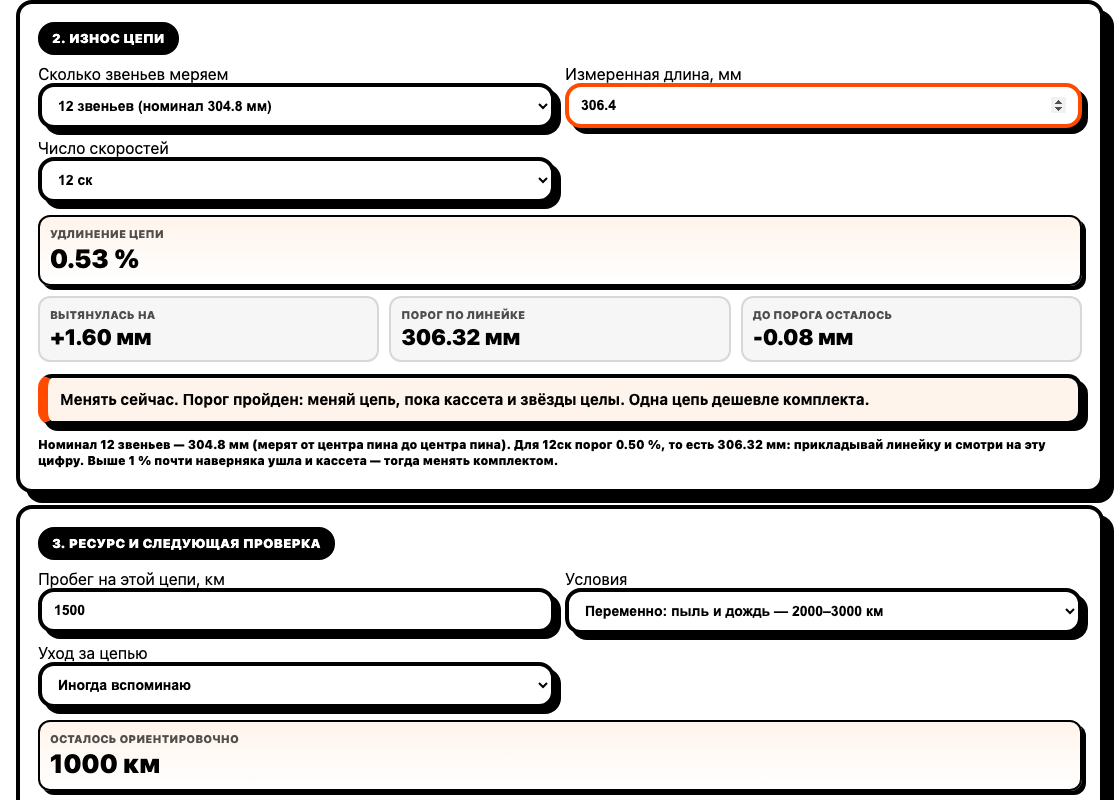
The nominal chain pitch is 12.7 mm. Between the centers of the pins after 24 interpin gaps it will turn out 304.8 mm. In our circuit calculator this base is signed "12 links (nominal value 304.8 mm)": here we mean pairs of internal and external links. Be guided by the specified length of the base, so as not to make a mistake twice.
Do not measure from the outer edge of one roller to the other instead of the pin centers. For a small percentage of wear, such an error is significant.
2. Convert the measurement to a percentage
The elongation formula: (measured length / nominal length − 1) × 100 %. For 306.4 mm based on 304.8 mm, this is approximately 0.525%; in the interface, after rounding, it is 0.53%. Enter these numbers and check the measurement base next to the field.
If you choose a double base of 609.6 mm, you need to re-measure the corresponding area. Do not leave the length taken from the short base. It is useful to compare the two dimensions, but they should not replace each other.
3. Check the threshold with the manufacturer
For many modern multi-speed circuits, thresholds of 0.5 or 0.75% are important, but the specific solution depends on the system and the meter. Park Tool explains measurement methods and typical thresholds; the instruction of the manufacturer of your chain takes precedence.
The number of speeds in the calculator selects a common threshold, and does not recognize the model. The forecast of the remaining mileage is even rougher: it depends on the chosen conditions and care. The remaining "1000 km" does not cancel the already measured maximum wear.
Gaps under load and damaged links require a separate check. A new chain does not always eliminate the problem of a worn cassette — this can be estimated in workshop.
4. Calculate the reference point for the new chain
In the length block, specify 1x or 2x, the length of the lower feathers from the center of the carriage to the axle of the rear wheel, the large front star and the large star of the cassette. The result is the approximate number of links and the difference with the blanks 116 or 126.
For example, for 425 mm feathers and 40/52 stars, the tool formula outputs 114 links, and the girth method shown next to it may give a different result. This is a reason to check the instructions, and not cut off the chain on the first number.
For a two-suspension, it is necessary to take into account the change in the distance during suspension operation; for individual systems, the manufacturer sets its own order and the addition of links. The universal "big–big plus two" is not suitable for all transmissions.
5. Check compatibility and installation
Before shortening, check the chain model, installation direction, lock or connection pin, and whether the connector can be reused. The number of gears by itself does not guarantee compatibility; start with guide to standards.
Perform the final length and check of the switch operation according to the instructions of your system. Scroll the transmission effortlessly, check the shifting and tension, then do a short test ride before the race. If there is no exact guide or the result is in doubt, keep the shortened chain and contact a mechanic.