The chain slips under load: what to check
You press the pedal, hear a crunch, and lose support for a moment. Two details are important: the chain jumps to the adjacent sprocket or remains on the same one, and the failure occurs always or only under force.
When to stop the ride
If there is only a click and the pedal maintains support, start with... articles about clicks under load. The same sound can accompany different events.
1. Write down what happens to the gear
Think about the failure that has already happened; there is no need to deliberately reproduce it with more force. Write down the gear, sitting or standing position and the date of occurrence. It is especially useful to know whether it started after replacing the chain, wheel or cassette.
- The chain goes to the next star
- A check of shifting is needed. Go to gear diagnostics.
- The gear remains the same, but under force a skip occurs
- The Park Tool connects such a scenario, especially on individual frequently used stars, with the possible wear of the chain and stars. This is a direction of verification, not a ready-made diagnosis.
- Couldn't see the chain movement
- So inform the technician. The record «the pedal has sunk, the chain position is unknown» is more useful than a confident but unconfirmed conclusion.
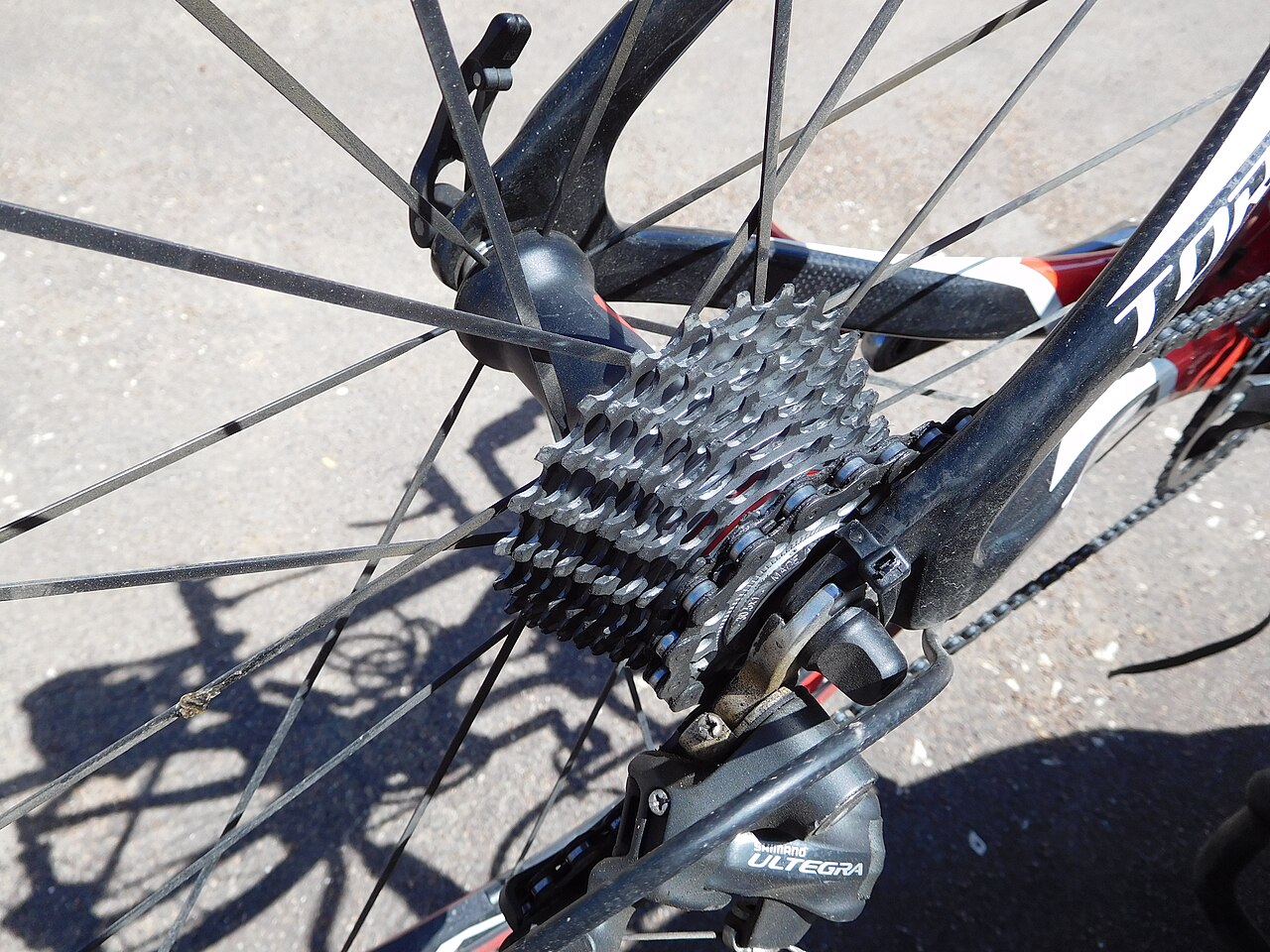

2. Inspect the chain on a stationary bicycle
Turn off the electric drive, if there is one. Inspect the accessible section of the stopped chain; move it by pedaling only after you have removed your hands. Look for damaged plates, an unusually protruding pin, and an incomplete lock. If in doubt about the chain connection, service is needed.
To assess wear, you need a suitable gauge and instructions for your chain. Park Tool explains wear measurement; the number on the tool cannot be automatically considered a threshold for any transmission. If there is no meter, ask for a measurement at the workshop.
A new chain does not rule out the problem of sprockets. In SRAM manual Wear and compatibility are considered before the final adjustment of shifting. Report the exact models of the installed chain and cassette. Do not evaluate the shape of the teeth by the principle of 'sharp means worn out': differences may be provided by the design.
3. What service to order
Select workshop specializing in transmission work and your city. For example, the catalog has Crazy Pedros Workshop. Specify the maintenance of your system when booking.
Ask skipping diagnostics under load: checking the connection and wear of the chain, condition of the sprockets, compatibility and shifting. If there is no visible jump, also ask where the power transmission is lost. Do not pre-order mandatory replacement of the entire transmission.
After repair, clarify the found cause and conditions for checking. The absence of a malfunction when pedaling in the stand does not yet confirm the problem has been fixed if it only occurred under load.
Sources and boundaries of verification
The material was prepared by the FATRACING editorial office for technical manuals. The inspection by the invited mechanic has not yet been carried out. The instruction of your model determines the order of maintenance, tightening torques and compatibility.
- Park Tool: Rear Derailleur Advanced Troubleshooting — nature of the skip.
- Park Tool: When to Replace a Chain — wear measurement.
- SRAM: Rear Gear Adjustment — condition and compatibility of parts.
The sources were verified on October 9, 2026. The workshop does not act as a reviewer of the article.