How to compare the geometry of two bikes before buying
The size M from two manufacturers does not have to mean the same frame. Start with the geometry of the bike you are comfortable on, and compare with the specific year and size of the candidate.
1. Find the right tables
If you are choosing your first bike and don't yet know your size, start with... selecting size by height and inner seam. Comparing geometry is useful for frames that are already in the suitable range.
Take the geometry from the manufacturer's website for the exact model, year and usury. Do not mix data of different generations: the same name does not guarantee an unchanged frame. Please note for which fork and its position the dimensions are given.
In comparing geometry frame A serves as a base, B is a candidate, C is an optional third option. There are already training numbers on the page. Replace them with your own, including options that are easy to miss below the first screen.
2. Transfer the data without shifting the columns
Enter the name and size of each frame. Quick input expects the numbers in the order indicated on the page: stack, reach, ETT, steering angle, seatpost angle, feathers, base, carriage drop, steering tube, fork departure.
For example, the training line 571 383 563 71,5 73,5 425 1030 72 145 50 sets stack 571 mm and reach 383 mm. After "Disassemble", check each field with the table. Do not insert the entire manufacturer row if the order of the columns is different.
It is better to check the unknown size with the manufacturer than to replace it with zero or a number from a neighboring model. For calculated wheel parameters, check the rim ETRTO and tire width.
3. First compare stack and reach
Stack — vertical, reach — the horizontal component of the position of the upper point of the steering tube relative to the center of the carriage. These are the dimensions of the frame; the real grip point also depends on the cockpit.
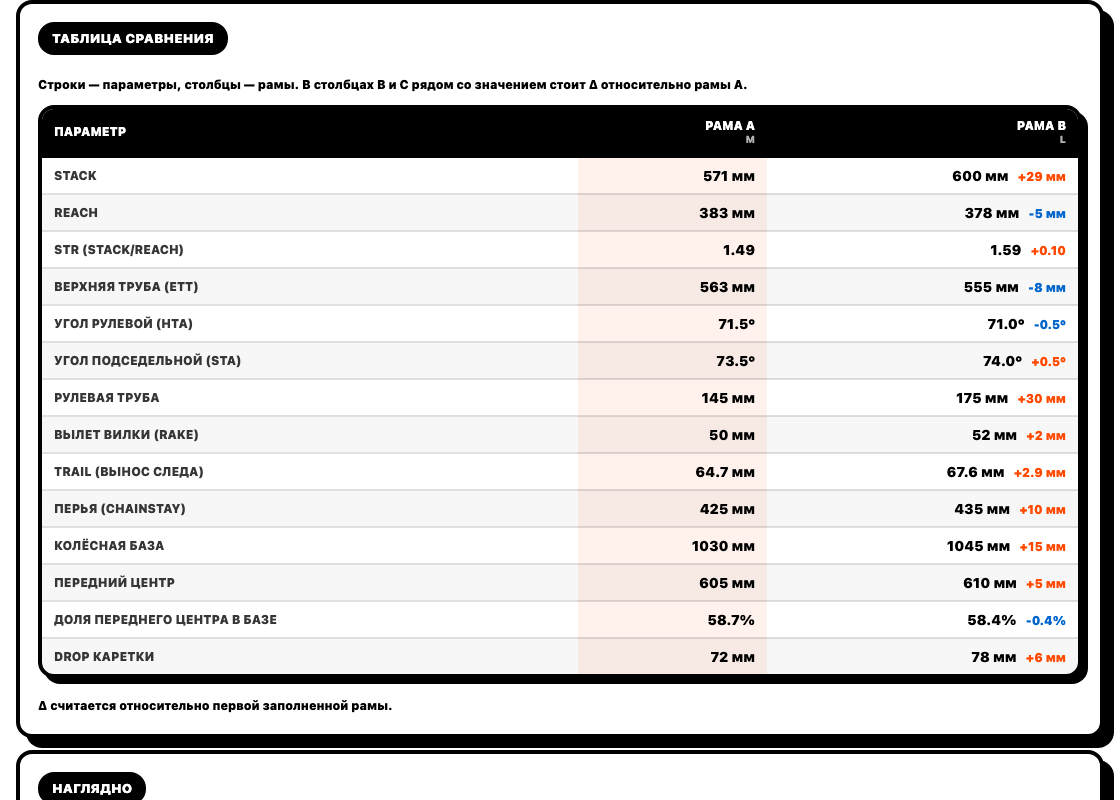
The example bike A has 571 mm stack, 383 mm reach; the B has 600 mm and 378 mm. The difference of B relative to A is +29 mm on stack and -5 mm on reach. B has a higher and slightly closer upper steering point, but this does not mean exactly such a difference in the position of the hands.
The stack/reach ratio helps you quickly compare proportions. Names like "comfort" in the output of the calculator are a conditional interpretation, not a selection of the size for a person.
4. Look at the base, corners and fork
Compare the wheelbase, the length of the feathers, the steering angle and the fork reach. They work together; it is impossible to confidently describe controllability by one number. The calculated trail also depends on the size of the wheel.
Check the seatpost angle and carriage height. The difference in angle changes the position of the saddle at the same height, and the drop of the carriage is not equal to its height above the ground. For a full-fledged comparison, the same units and understandable initial conditions are needed.
The geometry table does not confirm the clearance for the selected tire, axle and bottom bracket compatibility, or the maximum fork length. Look for these specifications separately in the frame specifications.
5. Translate the comparison into a solution
If the frame is suitable for its intended purpose, proceed to calculation of landing: Enter the take-out, spacers and saddle position. Guide by transferring the landing explains exactly what this model compares.
Save the link from the calculator and the original tables. If possible, confirm the choice by fitting or working with a bikefitter especially if the current landing itself raises questions.