How to transfer the landing to another bike
Rearranging the take-out of the same length is not enough: a different frame and steering angle will change the position of the steering wheel. The calculator helps to compare the coordinates of two assemblies and narrow down the choice of parts.
1. Fix the original assembly
In the landing calculator bike A — current, B — new. First make sure that landing A really want to repeat. The calculator itself does not determine the optimal position of the body.
You will need stack and reach frames, steering and seatpost angles, spacers along with the topcap, the height of the take-out clamp, its length and angle. For the saddle, the height of the seatpost and the forward shift from its axis are indicated. Follow the captions of the fields: the vertical height of the saddle above the carriage is another dimension.
Shoot comparable sizes in one way, write down the model of the saddle and steering wheel. For measurements, use a stable bicycle; take the original frame tables from the manufacturer.
2. Read the coordinates and signs
The origin is the center of the carriage. X is pointing forward, Y is pointing up. A negative X of the saddle means that the calculated point is behind the carriage.
Under the "steering wheel", the model considers the center of the steering wheel clamp to be an extension, and not the palms on the mannequins. The shape and rotation of the steering wheel, the reach of the steering wheel and the position of the handles are not specified here. The drop and departure of the saddle–handlebar therefore describe the geometry of the model, and not all the points of contact of the cyclist.
3. Compare A and B with an example
In the original example, A has a stack/reach of 595/390 mm, B has a stack/reach of 570/400 mm. Steering angles — 71.5° and 72.5 °, spacers — 20 and 15 mm. The takeaways are the same: 100 mm, -6°, clamp 40 mm.
The calculation gives the steering position for A approximately X = 475, Y = 655 mm, for B — X = 487, Y = 623 mm. Difference before rounding: +12.5mm forward and -31.3 mm down. The same take-out did not preserve the steering position.
These are tutorial builds, not a size recommendation. Fill in both bikes entirely: the remaining default values are also included in the calculation.
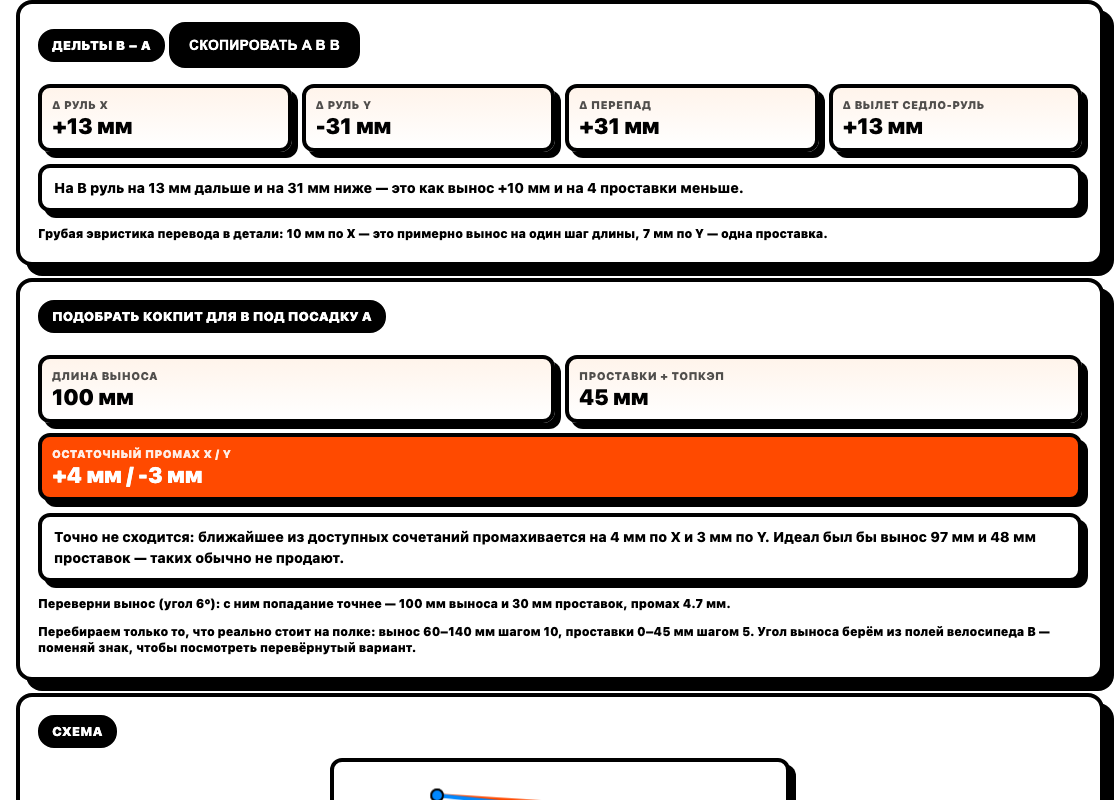
4. Choose the cockpit option
Use the take-out and spacer selection block for B, then estimate the residual coordinate difference. The selection works with the set of lengths and heights available in the tool; a close match in the model does not guarantee that the part can be installed on your fork.
Check the length of the remaining stem, the allowable height of the spacers, the clamping requirements and the compatibility of the integrated cockpit. The manufacturer's restrictions are more important than the calculator's offer. Do not compensate for a distant steering wheel by shifting the saddle just for the sake of matching one number.
5. Check the assembled bike
After assembly, re-measure the position of the steering wheel and saddle. Additionally, compare the slope and shape of the saddle, the position of the manettes, the length of the connecting rods and shoe settings: the model does not take these differences into account.
First, evaluate the landing in a short familiar trip. If there is pain or numbness, do not consider the coincidence of coordinates as proof of the correct landing. For individual settings, refer to Bike fit specialist.
Save the link to the calculation along with the measurements — it will be useful when discussing details with a mechanic.