How to choose gears for lifts
If you have to push the pedals slowly on the rise, first compare the lightest transmission of the current bike and the intended assembly. The calculator will show the difference before purchasing the parts.
1. Enter the current transmission
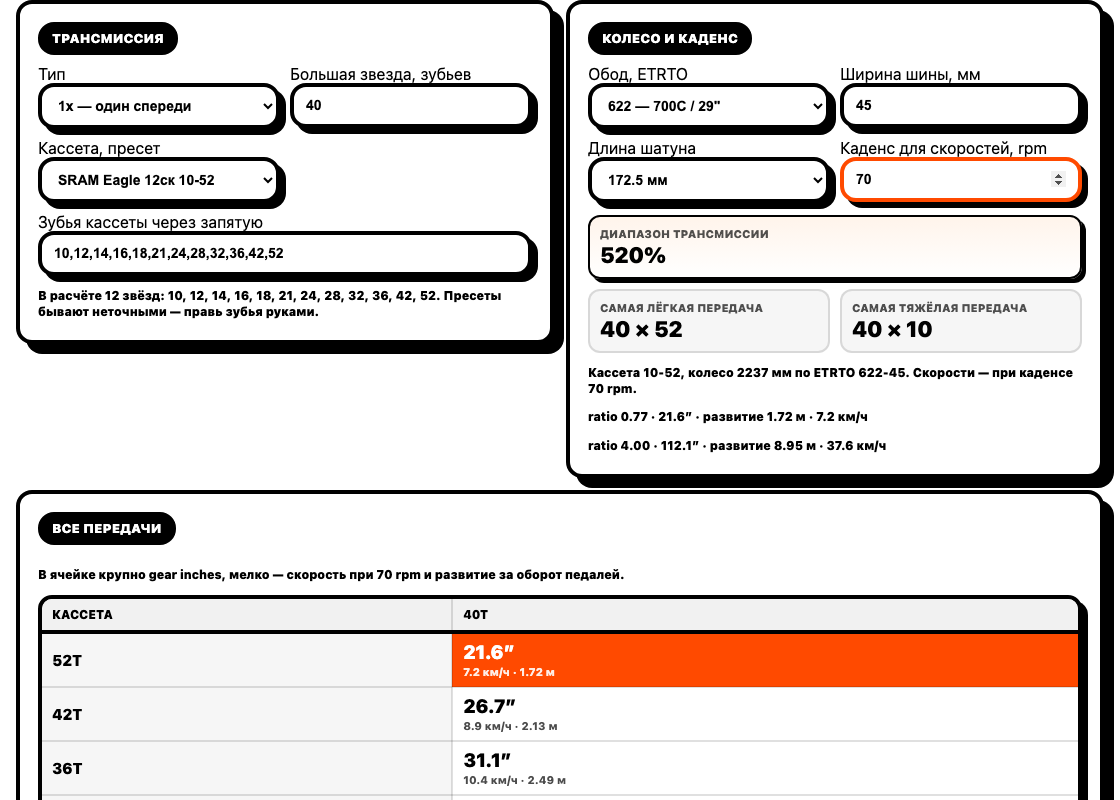
Open it "Transmission range". Select 1x or 2x, specify the front stars and all stars of the cassette. 2x needs both front stars. If you are using a ready-made preset, check it with the marking of your cassette.
Fill in the ETRTO rim diameter, tire width and cadence to calculate the speed. Do not confuse the rim diameter of 622 mm with the outer diameter of the wheel. Identical stars with different wheels give different development.
2. Read the light transmission
Gear ratio — the number of teeth of the front star divided by the number of teeth of the rear. For 40/52 it's about 0.77. The smaller the ratio for the same wheel, the smaller the path for one turn of the pedals.
Development — this path is in meters. The speed also depends on the cadence. The percentage range shows the ratio of the heaviest gear to the lightest; by itself, a large range does not say whether the lower gear is light enough.
3. Compare 40 and 36 teeth in one example
Set 1x, star 40 and cassette 10,12,14,16,18,21,24,28,32,36,42,52. For a 622 ×45 wheel, the calculation will give about 1.72 m on the easiest gear. At 70 rpm, this is approximately 7.23 km/h.
Now change only the front sprocket to 36. The development will decrease to 1.55 m, the speed at the same cadence is up to 6.50 km/h. The ratio has decreased by 10%. This allows you to go slower with the same pedal rotation, but does not mean that the climb will require 10% less energy.
4. Use the lift calculation as a guide
In the lift block, specify the slope, the mass of the entire system — bike, person and things — and the desired cadence. FTP can be added if you know its actual value.
For the example above, at 12%, 85 kg and 70 rpm, the model shows approximately 220 watts with 40/52 and 198 watts with 36/52. In the second case, the speed is also lower. The drag coefficients in the model are fixed; ground, wind, grip and variable slope can noticeably change the result.
The signature "you will stop by" is the output of the model, and not a guarantee of passing a specific lift. Compare the calculation with your stable capacity and the duration of the site.
5. Check the remaining transmissions and compatibility
A smaller front star reduces the heaviest transmission as well. Check the speed on fast sections, the steps between the stars and the doubles at 2x. If you change the cassette, look not only at the extreme teeth: the gaps also affect the convenience of choosing a cadence.
Before buying, separately check the drum, the maximum sprocket and the capacity of the switch, the compatibility of the chain and the fastening of the front sprocket. The calculator considers the relationship, but does not confirm mechanical compatibility. For this there is separate checklist.
Save the link to the calculation from the field on the page: this way you can show both options to the mechanic and return to the original values.