How to calculate the power for a long race
The purpose of the calculation is to turn the expected time at a distance into an understandable stock of products and a plan for replenishing water. The resulting version should be checked during training and coordinated with your load and nutrition tolerance.
1. Estimate the time, not just the kilometers
In the power calculator select calculation by time or distance. If you set the speed, take into account the stops and terrain: the average of a short fast workout may underestimate the duration of the race.
Enter the mass, intensity, temperature, sweating rating and volume of the flask. The flag of a trained gastrointestinal tract does not mean a desire to eat more — it should correspond to already proven experience. Caffeine for the first calculation can be left off.
2. Read the carb goal
See separately grams per hour and total grams per distance. In the recommendations Australian Institute of Sport for a load of 1-2.5 hours, a range of 30-60 g / h is indicated, for a longer one — up to 90 g / h; high amounts require a suitable strategy and tolerability. These are guidelines for sports nutrition, and not a mandatory norm for each participant.
The calculator uses a simplified model. Its upper figure should not become the first experiment on the day of launch. Do not increase consumption just for the sake of coinciding with the calculation. In case of diseases, dietary restrictions or recurring problems with the load, the plan should be sorted out with a specialist.
3. Convert the example into real products
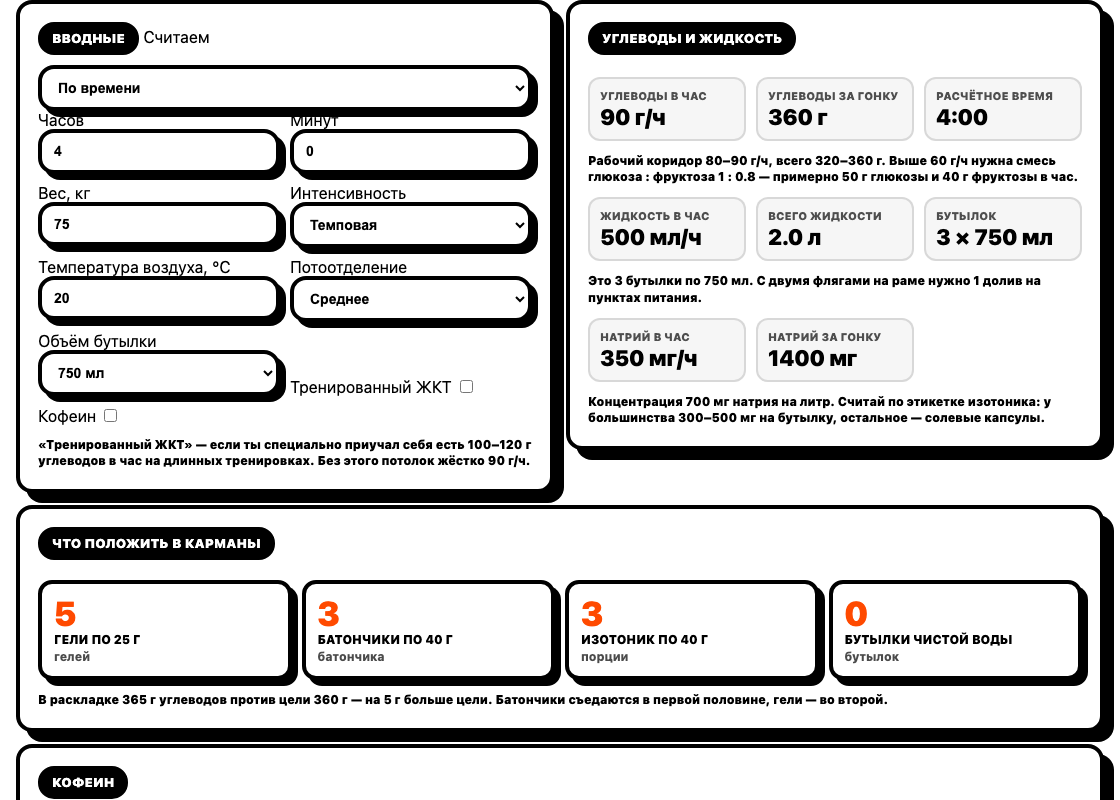
For the conditions specified in the signature, the model produces 80-90 g/h, a total of 320-360 g. The layout for the upper limit uses five gels of 25 g, three bars of 40 g and three portions of 40 g isotonic: 125 + 120 + 120 = 365 g.
These are conditional portion sizes. Take the label of your product: there may be 20 or 40 grams of carbohydrates in another gel. Count grams of carbohydrates, not package weight or calories. Carbohydrates in the drink are already included in the amount — they cannot be added again.
If your verified quantities are lower, make your own layout based on them. For example, four hours of 60 g/h — 240 g of carbohydrates in total; this is an arithmetic example, not a new personal norm.
4. Plan your water replenishment
In the training calculation, 500 ml / h and 2 liters are obtained in four hours. Three 750 ml flasks give 2.25 liters of capacity; this is a rounding up of the amount of containers, and not a requirement to drink everything. The calculator does not measure your sweating, and the weather and intensity may change.
Write down the food items and the longest section between them. Two 750 ml flasks — only 1.5 liters at the start; the remaining water must be obtained along the route. Check the availability of water and food from the organizer, and measure the powder for replenishment in advance.
In the calculation, sodium is indicated in milligrams of sodium, not salt. Read the labeling of the drink carefully. Do not try to perform the volume of fluid mechanically contrary to well-being.
5. Check the plan before the race
Test the selected foods, the concentration of the drink and the way to get them during training. Spread out the stock along the segments between the food points and take into account the possible delay on the way. The plan should be feasible on your route, and not just converge in the table.
Caffeine is optional. If you use it, consider coffee, drinks and gels together; the limit suggested by the calculator is not a personal safe tolerance.
Save the link from the calculator field and a short memo with the schedule. After the workout, note what you actually ate, drank, and tolerance to adjust the plan.